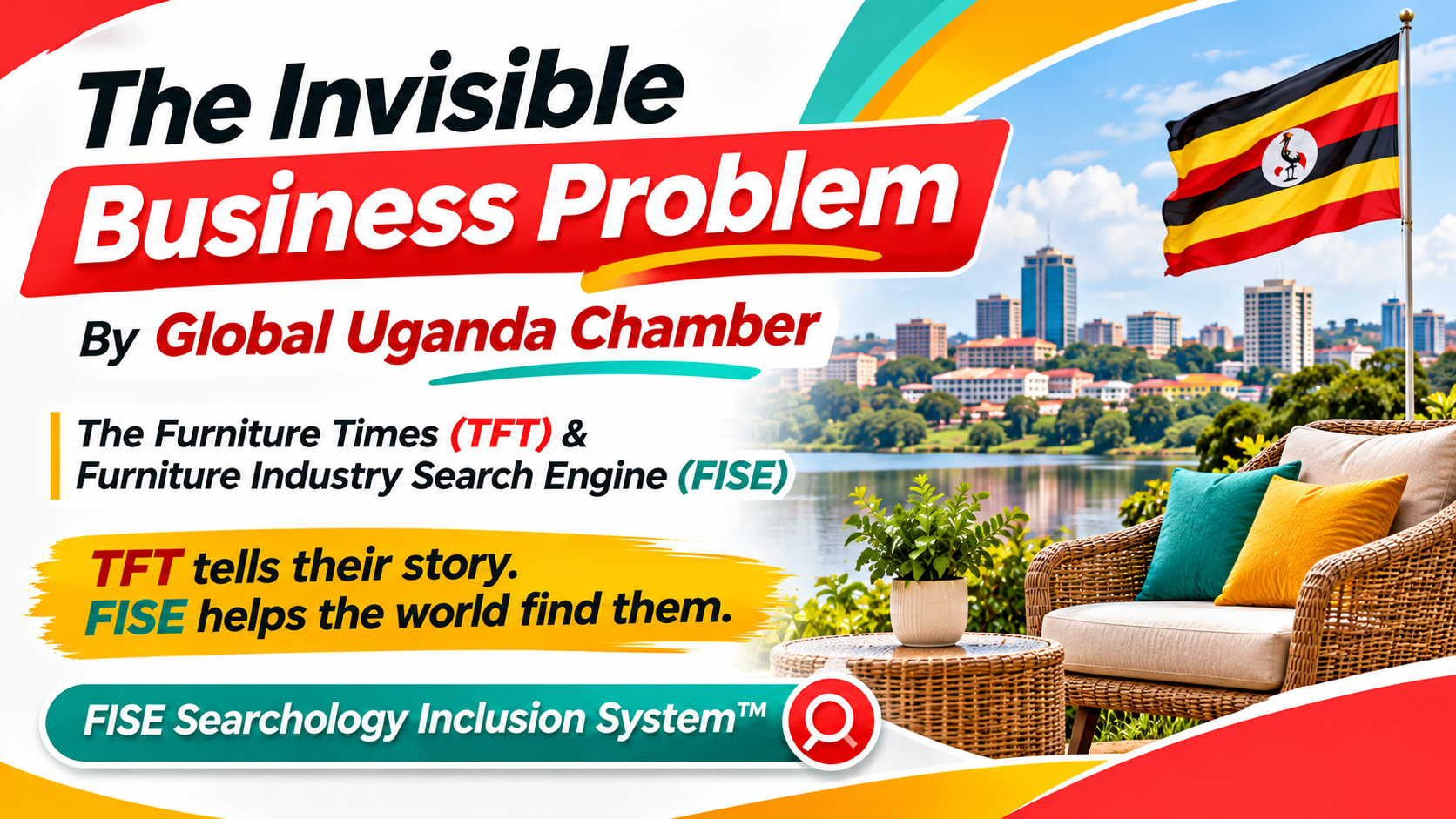
How Global Uganda Chamber, The Furniture Times (TFT), FISE, FISE LIVE and the FISE Searchology Inclusion System™ are advancing a new vision for business visibility, digital identity and global opportunity.
By Global Uganda Chamber
There is a problem affecting thousands of businesses that rarely receives the attention it deserves. It is not necessarily poor product quality. It is not always a lack of ambition, talent, or entrepreneurial experience. It is something much harder to recognize: business invisibility.
A business can have excellent products, skilled employees, competitive prices, loyal customers, and years of experience, yet remain unknown outside its immediate market. A manufacturer can be ready to supply international buyers but struggle to get discovered. An artisan can produce exceptional work without having a digital identity that communicates its value. A small business can have everything required to grow except access to the visibility that brings new opportunities within reach.
This is the invisible business problem.
And it is costing entrepreneurs more than they realize.
In today’s interconnected economy, being good at what you do is important, but being discoverable is becoming equally important. Customers search before they purchase. Buyers investigate before they establish partnerships. Investors research before they initiate conversations. Business opportunities increasingly begin with a search, a digital profile, a recommendation, or an online discovery.
If your business cannot be found when the right opportunity is looking for what you offer, someone else may receive that opportunity instead.
For businesses across Uganda and beyond, this challenge deserves serious attention. Through the Global Uganda Chamber and the wider digital visibility vision involving The Furniture Times (TFT), Furniture Industry Search Engine (FISE), FISE LIVE, and the FISE Searchology Inclusion System™, a bigger conversation emerges: how can we help businesses become more visible, discoverable, and connected to the global marketplace?
The answer begins with recognizing that invisibility is not always a business failure. Sometimes, it is a visibility failure.
The Business That Exists but Nobody Finds
Imagine a furniture manufacturer in Uganda producing quality tables, chairs, beds, and customized furniture. The company has skilled craftsmen, reliable production capabilities, and the ambition to serve larger markets.
A buyer in another country is searching for a furniture supplier.
The buyer has a requirement. The manufacturer has the capability. There is a potential commercial connection.
But the buyer never discovers the manufacturer.
Why?
Perhaps the company has no properly structured digital profile. Perhaps its website does not explain its capabilities. Perhaps its business information is scattered across social media platforms. Perhaps its products are not presented in a way that helps search engines and potential customers understand what it offers.
The opportunity disappears before a conversation even begins.
Now consider an independent Ugandan artisan producing handmade products. The craftsmanship is exceptional, but the business has limited digital exposure. Customers who would appreciate the work may never encounter it.
Consider a small agricultural supplier, a technology startup, a fashion entrepreneur, a local manufacturer, or a grassroots creator. Each may have something valuable to offer, but limited discoverability can restrict access to new audiences.
These are not isolated situations. They represent a broader challenge facing businesses that have not yet established a strong digital identity.
The marketplace cannot consider a business it cannot discover.
This is why entrepreneurs must stop treating online visibility as an optional marketing activity. It is an increasingly important part of business development.
The Invisible Business Problem Is Bigger Than Marketing
Many entrepreneurs believe visibility simply means posting regularly on Facebook, Instagram, LinkedIn, or other social media platforms.
Social media matters. Advertising can help. Websites are valuable. But digital visibility is much broader than publishing promotional content.
A business needs to communicate its identity consistently across the digital environment.
Can someone find the company by searching its business name? Can a prospective customer understand what it sells within a few seconds? Are its products and services clearly described? Is its location accurate? Can buyers identify its capabilities? Is there a professional way to make contact?
These questions reveal whether a business is genuinely discoverable or simply present online.
There is a difference.
Having a social media account does not automatically create a strong digital identity. Having a website does not guarantee search visibility. Having excellent products does not guarantee that potential buyers will encounter them.
Businesses need information that is organized, relevant, accessible, and useful.
They also need to understand that digital discovery is not controlled by a single platform. Search engines, social networks, industry publications, business directories, professional networks, and emerging AI-powered discovery systems all influence how people encounter businesses.
Entrepreneurs who ignore these developments risk becoming increasingly difficult to find.
The biggest competitor to an undiscovered business is not always another company. Sometimes, it is the business that customers find first.
Uganda Has Businesses Worth Discovering. The World Needs Better Ways to Find Them.
Uganda has an entrepreneurial ecosystem with businesses, innovators, manufacturers, service providers, traders, agricultural enterprises, artisans, designers, and emerging creators contributing to economic activity.
Behind these enterprises are people creating products, developing solutions, building livelihoods, and pursuing opportunities.
Yet entrepreneurial potential and international visibility do not always grow at the same pace.
A business may have the capacity to serve customers beyond its local area but lack the digital infrastructure to communicate that capability. An artisan may have valuable skills but limited access to audiences that appreciate handmade products. An SME may have a promising product but struggle to establish relationships with distributors, retailers, or international buyers.
The challenge is not simply getting more businesses online. It is helping businesses become easier to identify, understand, evaluate, and contact.
This is where the Global Uganda Chamber has an important role to play in the broader conversation about business connectivity and visibility.
The future of business growth should include stronger opportunities for Ugandan enterprises to introduce themselves to wider audiences, establish meaningful relationships, and participate in a more connected global marketplace.
A business should not be defined only by the size of its marketing budget or the geographical boundaries of its immediate market.
Its value should have an opportunity to be discovered.
Global Uganda Chamber: Building a Stronger Conversation Around Business Visibility
Business growth rarely happens in isolation.
Entrepreneurs need relationships. Businesses need customers. Manufacturers need buyers. Startups need partners. Service providers need people who understand the value they deliver.
Chambers of commerce and business networks can play an important role in creating environments where these relationships become possible.
The Global Uganda Chamber represents a platform around which the importance of business visibility, entrepreneurship, connectivity, and wider market participation can be communicated.
For Ugandan businesses, the opportunity is to think beyond simply operating a company and start building a recognizable business identity.
What does your company offer? What makes your products or services relevant? Which markets could benefit from your capabilities? What information would an international buyer need before contacting you?
These are important questions for every entrepreneur.
A stronger business ecosystem requires more than individual companies working independently. It benefits from visibility, communication, knowledge sharing, and meaningful connections.
The larger objective is to help businesses move from being locally known to becoming easier to discover in a wider marketplace.
Because a business with potential should have a pathway to introduce that potential to the world.
The Furniture Times (TFT): Every Business Has a Story Worth Telling
A business is not just a name, logo, product catalogue, or company registration.
It is a story.
Behind every enterprise are decisions, challenges, people, experience, innovation, and determination. Some businesses are built through generations of craftsmanship. Others emerge from a founder’s desire to solve a problem. Some grow from small workshops into established manufacturing operations.
These stories deserve attention.
The Furniture Times (TFT) represents the storytelling dimension of this broader visibility vision.
Its guiding philosophy is simple:
TFT tells their story.
Why does business storytelling matter?
Because people want to understand the businesses behind the products and services they consider.
A furniture manufacturer may have invested years in improving production quality. An artisan may preserve a traditional technique. A startup may have developed an innovative solution to a local problem. A small enterprise may be creating employment and supporting its community.
These details communicate more than a sales message. They provide context, identity, and an understanding of what makes a business distinctive.
For SMEs, industry storytelling can help communicate their experience, capabilities, products, and ambitions to audiences beyond their existing customer base.
For entrepreneurs, it creates an opportunity to explain not only what they sell but also why their work matters.
For the wider business community, it creates greater awareness of the people and enterprises contributing to economic development.
The world is full of businesses with remarkable stories. The problem is that many of those stories never reach the audiences that should hear them.
TFT’s vision recognizes that visibility should include the human story behind the business.
FISE: Helping the World Find Businesses That Deserve Attention
A compelling story is valuable, but people must also be able to discover the business behind it.
This brings us to the Furniture Industry Search Engine (FISE).
FISE helps the world find them.
FISE represents the discovery dimension of the wider digital visibility ecosystem. Its vision is to help organize and connect relevant industry information so businesses can become easier to find.
Consider what happens when an international buyer searches for a manufacturer, supplier, furniture designer, or specialized product.
The buyer is not simply looking for a business name. The buyer needs relevant information.
What does the company manufacture? Which products does it offer? Where does it operate? What capabilities does it have? How can the buyer initiate contact?
A structured discovery environment can help make this information more accessible and useful.
Although FISE is positioned around the furniture industry, the broader principles of its discovery philosophy connect to an important challenge facing SMEs: the need to make business information easier to find and understand.
For manufacturers, discovery can create opportunities to introduce production capabilities.
For suppliers, it can improve the presentation of products and services.
For designers and artisans, it can help communicate specialized work.
For buyers, it can provide another starting point for identifying potential businesses and industry connections.
Discovery does not guarantee a contract, ranking, or sale. Businesses must still demonstrate quality, reliability, competitive value, and the ability to meet customer requirements.
But the first step is often being found.
TFT tells the world who you are. FISE helps the world discover where you are.
Together, storytelling and discovery offer a more complete perspective on digital business visibility.
FISE LIVE: Moving Beyond Static Business Presence
The digital world is moving toward more interactive experiences.
Customers increasingly expect accessible information, responsive communication, and meaningful ways to engage with businesses.
A static business profile may introduce a company, but businesses also need opportunities to communicate, demonstrate their offerings, and establish relationships.
FISE LIVE forms part of the wider FISE vision, bringing an additional dimension to digital industry participation and business engagement.
For entrepreneurs, the larger opportunity is to think beyond simply placing information online.
A business should be prepared to communicate its value, answer enquiries, explain its capabilities, and build confidence with potential customers.
For a furniture manufacturer, this could mean presenting product information and production capabilities more effectively.
For an artisan, it could mean creating more opportunities for audiences to understand the craftsmanship behind the work.
For an SME, it could mean participating in a more connected digital environment where discovery and engagement support one another.
The real value of an interactive business ecosystem lies in the usefulness of its experience. It must help people access relevant information, communicate effectively, and take meaningful next steps.
The future of visibility is not just about being seen. It is about making discovery useful enough to encourage engagement.
FISE Searchology Inclusion System™: A Global Visibility Engine for Businesses That Are Often Overlooked
One of the biggest challenges in the digital economy is unequal access to visibility.
Large corporations often have dedicated marketing departments, professional content teams, substantial advertising budgets, and established digital infrastructure.
Smaller businesses may have excellent products but limited resources to communicate their value.
Independent artisans may depend on word of mouth. Local makers may struggle to reach buyers outside their communities. Grassroots creators may have innovative ideas but limited access to digital exposure.
This creates a visibility gap.
The FISE Searchology Inclusion System™ is positioned around a vision of addressing this challenge by advancing discoverability and digital identity for SMEs, artisans, makers, and grassroots creators.
This is not just a business listing system.
It represents a broader ambition to make digital visibility more inclusive and meaningful.
Its vision can be understood through five interconnected dimensions.
1. A Livelihood System
Behind every small business is a livelihood.
A family may depend on a furniture workshop. A group of artisans may rely on orders to sustain traditional craftsmanship. A small manufacturer may employ workers whose income depends on the continuity of production.
When businesses become easier to discover, they may gain additional opportunities to reach customers, develop partnerships, and pursue new commercial relationships.
This is why the livelihood dimension matters.
The objective is to connect business visibility with the possibility of economic participation.
A business profile alone cannot create a sustainable income. Quality, customer demand, pricing, service, and reliable operations remain essential. But better discoverability can help businesses reach people who may otherwise never encounter their work.
The ultimate ambition is to help talent find opportunity.
2. A Human Impact System
Technology should not make people disappear behind databases and algorithms.
Every listing represents a real enterprise. Every product represents someone’s work. Every business opportunity can affect people, families, employees, and communities.
A human impact approach recognizes that digital visibility has significance beyond clicks and impressions.
Imagine an artisan whose work reaches a new market. Imagine a small manufacturer receiving an enquiry from a potential distributor. Imagine a grassroots creator finding an audience that appreciates an innovative product.
These are the kinds of possibilities that make business discovery meaningful.
The purpose is to put people and their work at the centre of the digital economy.
3. A Search Revolution
Search should help people find relevant information, not overwhelm them with disconnected results.
Businesses need to communicate their products, capabilities, locations, and specializations clearly. Buyers need information that helps them identify suitable suppliers and potential partners.
The FISE Searchology Inclusion System™ vision places search-led discoverability at the centre of this relationship.
A search revolution should focus on relevance, structured information, accessibility, and useful connections.
It is not simply about generating more listings. It is about improving the experience of finding businesses that meet specific needs.
For SMEs, this means taking business information seriously. For buyers, it means having better starting points for discovery.
4. A Digital Identity Movement
If people cannot clearly identify your business online, they may struggle to trust or understand it.
Digital identity is therefore an important foundation of modern business visibility.
A credible digital identity should communicate:
- Who the business is.
- What products or services it offers.
- Where it operates.
- What makes its offering distinctive.
- What capabilities it can demonstrate.
- How customers and partners can contact it.
For an artisan, this may include the story behind the craft and the materials used.
For a manufacturer, it may include product categories, production capabilities, and business information.
For a grassroots creator, it may include the identity, purpose, and value behind the work.
The goal is to make businesses easier to recognize, understand, and approach.
5. A Global Opportunity Engine
The internet has changed the boundaries of business discovery.
A company no longer needs to depend entirely on people walking through its doors or hearing about it through local networks.
A potential customer may be located in another city, another country, or another commercial ecosystem.
But international discovery requires more than ambition. Businesses need credible information, relevant visibility, clear communication, and the operational ability to serve customers.
The FISE Searchology Inclusion System™ vision recognizes the importance of creating more opportunities for SMEs, artisans, makers, and grassroots creators to participate in a wider digital economy.
Its larger ambition is to help reduce the distance between businesses with valuable offerings and the people searching for them.
Why Being Invisible Can Be More Expensive Than You Think
Entrepreneurs often calculate the cost of raw materials, employee salaries, transportation, rent, equipment, and production.
But how many calculate the cost of missed discovery?
Consider a manufacturer that never receives an enquiry because its products are difficult to find online.
Consider an artisan who loses potential customers because there is no clear way to discover the business.
Consider an SME that repeatedly competes for the same local customers because it has not developed a strategy for reaching new audiences.
These missed opportunities may never appear in a financial report.
There is no invoice for the customer who never found you. No notification for the partnership that went to another supplier. No record of the international buyer who searched for your product but encountered a competitor first.
That is what makes invisibility dangerous.
It operates quietly.
Businesses may assume that demand is low when the real problem is that relevant customers do not know they exist.
They may reduce prices when they actually need better positioning. They may produce more promotional content without addressing the discoverability of their business information.
They may blame competition without reviewing whether their own digital presence is strong enough.
This is why every entrepreneur should ask an uncomfortable but important question:
If someone searches online today for exactly what my business offers, will they find me or my competitor?
The answer deserves more than a quick glance at social media.
It deserves a serious review of your entire digital identity.
Seven Actions Every Ugandan SME Should Take to Become More Discoverable
Understanding the invisible business problem is important. Taking action is what creates progress.
Here are seven practical steps businesses can begin implementing.
1. Build a Clear Digital Business Identity
Start with the basics.
Ensure your business name, contact information, location, website, and business descriptions are accurate and consistent.
A potential customer should not have to investigate multiple pages to understand who you are.
2. Explain Exactly What You Sell
Avoid vague descriptions.
If you manufacture furniture, specify the types of furniture you produce. If you supply agricultural products, explain which products you offer. If you provide professional services, identify the services and the customers you serve.
Specific information helps people understand whether your business is relevant to their needs.
3. Present Your Products Professionally
Use clear photographs, informative descriptions, and accurate product details.
Show customers what they are considering. Include relevant specifications, materials, sizes, variations, and other details that help them make informed decisions.
4. Publish Your Business Story
Explain how your company started, what problem it solves, what makes its offering distinctive, and what it aims to achieve.
Your story can help people understand the human and professional value behind your business.
5. Strengthen Your Search Visibility
Create useful website content around the products, services, and questions your target customers search for.
Use descriptive headings, relevant keywords, clear page titles, and structured information. Keep business details updated across relevant digital platforms.
Do not publish content simply to fill a page. Publish information that helps someone make a decision.
6. Explore Relevant Business Discovery Platforms
Do not depend on a single social media account to represent your entire company.
Explore appropriate industry platforms, business networks, directories, chambers, and discovery environments.
The goal is to make your business information available in places where relevant audiences may search.
7. Turn Every Enquiry into a Business Opportunity
Visibility is only useful when businesses are ready to respond.
Reply professionally. Provide accurate quotations. Share product information. Explain delivery timelines. Understand customer requirements and follow up appropriately.
Measure enquiries, qualified leads, conversions, and repeat business.
The ultimate objective is not merely to attract attention. It is to build relationships that create commercial value.
Why Global Business Discovery Needs Inclusion, Not Just Competition
The digital economy often celebrates the biggest brands, the most visible companies, and businesses with the largest marketing budgets.
But the world does not lack talent outside those organizations.
It contains thousands of smaller enterprises with valuable capabilities, innovative ideas, specialized products, and exceptional craftsmanship.
The challenge is helping those businesses become visible enough to participate.
A more inclusive discovery environment recognizes that a small artisan and a large manufacturer may serve different markets, but both deserve the opportunity to present their work professionally.
It recognizes that grassroots creators can contribute value without having the marketing resources of established companies.
It recognizes that SMEs are not simply smaller versions of large corporations. They often have distinctive capabilities, local knowledge, specialized products, and closer relationships with their communities.
This is why the FISE Searchology Inclusion System™ vision matters beyond conventional business listings.
It brings together the ideas of livelihood, human impact, search innovation, digital identity, and global opportunity.
Inclusion should not mean lowering standards. It should mean making access to meaningful discovery more achievable while maintaining the importance of credible information, business quality, and customer trust.
The global marketplace benefits when more capable businesses have a fair opportunity to be considered.
From Being Known Locally to Being Discovered Globally
A business may have strong relationships in its community but limited recognition elsewhere.
That is not necessarily a weakness. Local relationships are valuable foundations.
The next step is to communicate the business’s capabilities in ways that can reach relevant audiences beyond its immediate geographical market.
For a Ugandan furniture manufacturer, that may mean clearly presenting product categories, materials, production capacity, and contact information.
For an artisan, it may mean showcasing distinctive craftsmanship and explaining the value of handmade products.
For a technology startup, it may mean explaining its solution, intended users, and business model.
For an SME, it may mean building a digital presence that makes its products and services easier to understand.
Global visibility is not about pretending to be a multinational company. It is about making a genuine business easier to discover and evaluate, regardless of its size.
The right buyer may be closer than an entrepreneur thinks. But discovery must happen before a relationship can begin.
The Future Belongs to Businesses That Make Themselves Discoverable
The next generation of business competition will not be determined by product quality alone.
It will also involve information, digital identity, customer experience, accessibility, trust, and the ability to connect with relevant markets.
Businesses that understand this shift will be better positioned to adapt.
They will not wait until sales decline to improve their digital presence. They will not depend entirely on word of mouth. They will not assume that opening a social media account is enough.
They will treat discoverability as an ongoing business responsibility.
The Global Uganda Chamber, The Furniture Times, FISE, FISE LIVE, and the FISE Searchology Inclusion System™ represent a wider conversation about making business visibility more connected and inclusive.
TFT tells their story.
FISE helps the world find them.
FISE LIVE represents the interactive dimension of the wider discovery vision.
The FISE Searchology Inclusion System™ advances the ambition to make digital discoverability more meaningful for SMEs, artisans, makers, and grassroots creators.
Together, these ideas point toward a future in which business identity and discovery are not afterthoughts but important foundations of participation in the global economy.
The opportunity is significant, but businesses must also take responsibility for the information they publish, the quality they deliver, and the relationships they build.
No platform can replace a strong product, reliable service, or customer trust. But better visibility can help more people discover the value a business already creates.
The Final Question: Is Your Business Visible Enough to Be Chosen?
There are businesses working hard every day, creating products, delivering services, employing people, and solving problems.
Some are growing. Some are struggling. Some are ready for a bigger market but have not yet found the right audience.
Many share one challenge: the world does not know enough about what they offer.
That must change.
Entrepreneurs should stop asking only how to increase sales and begin asking how the right customers can discover their businesses in the first place.
They should stop treating digital identity as a decorative exercise and start treating it as a foundation of commercial credibility.
They should stop assuming that excellent work will automatically attract attention. In a competitive digital marketplace, value must be communicated, information must be accessible, and discovery must be made possible.
For Ugandan businesses, the opportunity is to build stronger digital identities and become more connected to wider markets.
For SMEs, artisans, makers, and grassroots creators, the opportunity is to ensure that limited marketing resources do not automatically mean permanent invisibility.
For industry partners and buyers, the opportunity is to look beyond familiar brands and discover businesses with valuable capabilities.
Your business may not have a visibility problem because it lacks value. It may have a visibility problem because the people who need what you offer have not found you yet.
Do something about it.
Review your digital presence. Tell your story. Improve your business information. Explore relevant discovery platforms. Build relationships. Make it easier for customers and partners to take the next step.
Because the business that gets discovered has an opportunity to compete for the business that would otherwise remain out of reach.
The world cannot choose what it cannot find.
Global Uganda Chamber: Advancing the conversation around business visibility, connectivity, and global opportunity.
TFT tells their story. FISE helps the world find them.
Are you a Ugandan entrepreneur, SME owner, furniture manufacturer, artisan, maker, supplier, startup founder, or grassroots creator?
Your next customer, business partner, or commercial opportunity could be searching for what you offer right now.
Do not wait until your competitors have established stronger digital identities. Start making your business easier to discover.
Explore the wider vision of Global Uganda Chamber, The Furniture Times (TFT), Furniture Industry Search Engine (FISE), FISE LIVE, and the FISE Searchology Inclusion System™.
Build your digital identity. Present your capabilities. Tell your story. Create opportunities for the world to find your business.
Your business deserves to be discovered. Your work deserves to be seen. Your next opportunity deserves a chance to find you.