There was a time when the best businesses were the ones people talked about.
Then came the internet, and the advantage shifted to the businesses people could find.
Today, something even bigger is happening.
The winners of the next economy will not simply be those with the best products, the most talented artisans, the most innovative ideas or the strongest stories. They will be the people and organizations whose identities, products, stories, locations and capabilities can be discovered, understood and connected across the digital world.
That is where data + discovery = dominance becomes more than a powerful statement.
It becomes a new economic reality.
For millions of SMEs, artisans, makers, manufacturers, grassroots entrepreneurs and emerging businesses, the problem has never been a lack of talent. The problem has often been visibility.
A furniture maker can create extraordinary products and still remain invisible.
A small manufacturer can produce at international standards and still struggle to reach buyers.
An artisan can spend decades perfecting a craft and still have no meaningful digital identity.
A grassroots creator can transform a community and yet remain almost impossible for the global market to discover.
The world is full of remarkable people who are simply difficult to find.
And in the digital economy, being difficult to find can become almost as damaging as being unable to compete.
This is the opportunity behind the work of the Global Uganda Chamber, together with The Furniture Times (TFT), Furniture Industry Search Engine (FISE) and FISE LIVE.
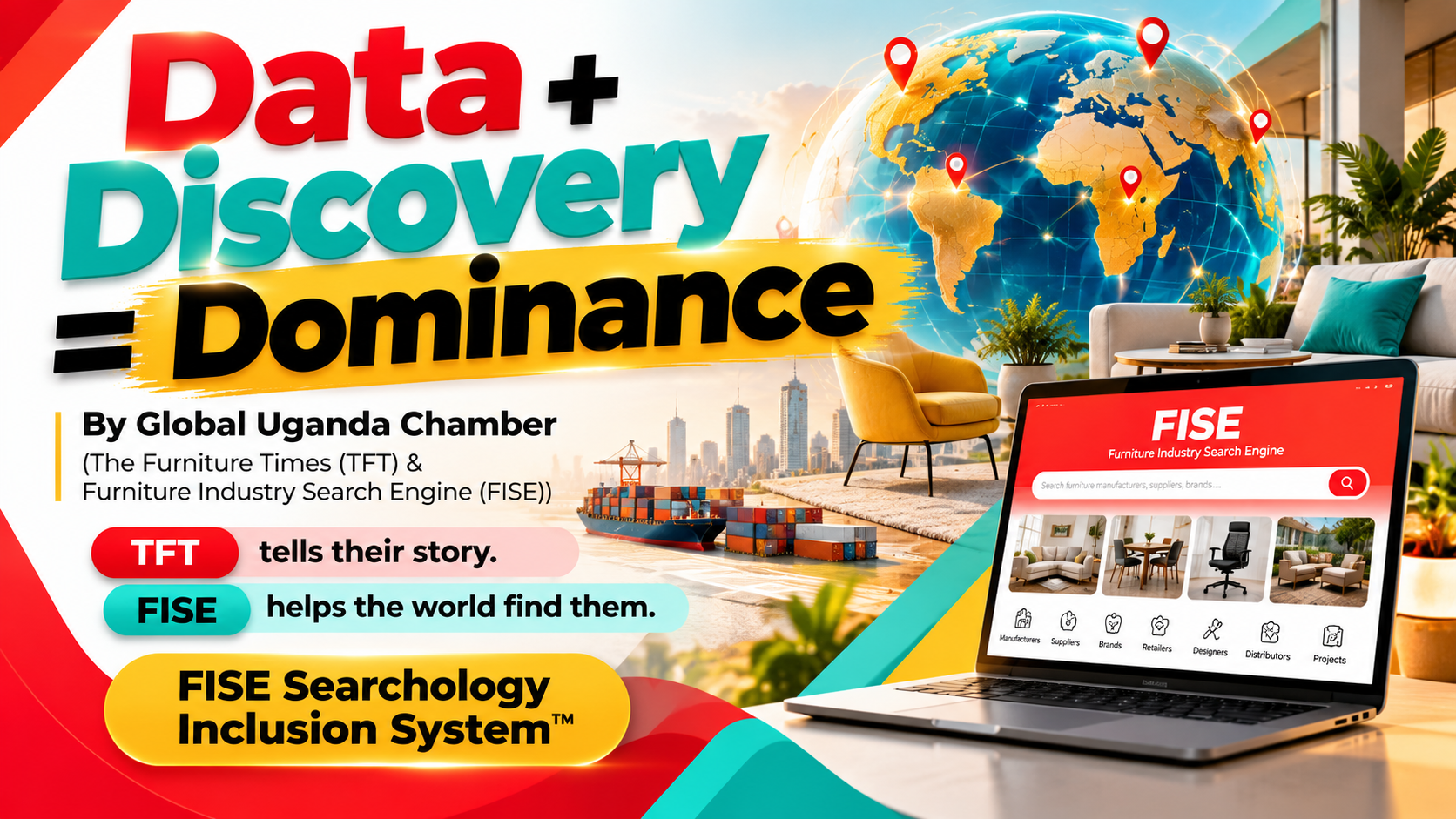
TFT tells their story.
FISE helps the world find them.
And together, the vision points toward something much bigger than another online directory.
It points toward a global visibility infrastructure for people whose work deserves to be discovered.
The world does not have a talent shortage. It has a discovery problem.
Think about the millions of businesses operating outside the spotlight.
They are building furniture.
Manufacturing products.
Creating handmade goods.
Designing interiors.
Producing materials.
Developing local solutions.
Employing families.
Training young people.
Preserving traditional craftsmanship.
Building communities.
Creating economic opportunity.
But ask a simple question:
Can the world find them?
That question changes everything.
Because discovery is no longer a luxury.
Discovery influences opportunity.
Discovery influences trust.
Discovery influences partnerships.
Discovery influences purchasing decisions.
Discovery influences investment.
Discovery influences exports.
Discovery influences whether an unknown business becomes a recognized brand.
The digital economy rewards what can be identified, understood and connected.
If a business has no structured digital identity, no discoverable information, no searchable story and no meaningful presence where buyers are looking, its capabilities can remain trapped inside a local market.
The business may be excellent.
But excellence without visibility can remain invisible.
Data is no longer just information. It is economic infrastructure.
When people hear the word “data,” they often think about spreadsheets, statistics, databases and technology.
But data can be much more human than that.
A business name is data.
A location is data.
A product is data.
A craft is data.
A founder’s story is data.
A manufacturing capability is data.
A certification is data.
A service area is data.
A photograph is data.
A product category is data.
A business history is data.
A community contribution is data.
When these pieces are structured properly, they create something powerful:
Digital identity.
Digital identity allows a business to communicate with the modern world even when its founder is sleeping, working in a workshop, serving a customer or running a production line.
It gives the market something to understand.
It gives search systems something to interpret.
It gives buyers something to evaluate.
It gives partners something to discover.
It gives communities a stronger digital footprint.
And it gives businesses a better chance of being found when opportunity comes searching.
Discovery is the missing half of digital growth
For years, businesses have been told to “go digital.”
Build a website.
Create social media pages.
Post content.
Run advertisements.
Make videos.
Send emails.
But there is a deeper question.
Digital for what?
If a business exists online but remains difficult to discover, understand or connect with, simply being online is not enough.
The next evolution is not merely digital presence.
It is digital discoverability.
This is why the relationship between data and discovery matters.
Data gives systems information.
Discovery puts that information in front of the right people.
Data creates identity.
Discovery creates opportunity.
Data tells the world who you are.
Discovery helps the world find you.
That is the philosophy behind FISE.
TFT tells their story. FISE helps the world find them.
The Furniture Times has a different role from a traditional business directory.
A directory can tell you that a company exists.
A powerful industry platform can help tell you why that company matters.
That distinction is important.
Because businesses are not merely names.
They are stories.
They are people.
They are factories.
They are workshops.
They are designers.
They are families.
They are communities.
They are years of knowledge.
They are risks taken by entrepreneurs.
They are jobs created.
They are dreams transformed into products.
TFT creates space for those stories within the furniture ecosystem.
FISE takes the next step by helping those identities become discoverable.
One tells the story.
The other expands the possibility of being found.
Together, they represent a powerful shift from simply publishing information to creating industry-wide visibility.
FISE is not just a business listing system
This distinction deserves attention.
Calling FISE simply a business listing platform would dramatically underestimate the vision.
The deeper idea is a livelihood system.
It is a human impact system.
It is a search revolution.
It is a digital identity movement.
It is a global opportunity engine.
Why?
Because behind every listing is a human being.
Behind every workshop is a family.
Behind every artisan is a story.
Behind every SME is a risk.
Behind every grassroots creator is an ambition.
And behind every discoverable business is the possibility of a new customer, a new partner, a new market, a new job, a new investment or a new opportunity.
This is why visibility has an economic dimension.
When a business becomes easier to discover, its possibilities can expand.
FISE Searchology Inclusion System™: Building visibility where it matters
The FISE Searchology Inclusion System™ introduces a powerful idea: the global digital economy should not be reserved for businesses that already have enormous marketing budgets.
SMEs deserve discoverability.
Artisans deserve discoverability.
Makers deserve discoverability.
Grassroots creators deserve discoverability.
Local manufacturers deserve discoverability.
Emerging entrepreneurs deserve discoverability.
Small businesses should not have to become multinational corporations before they can build a meaningful digital identity.
The purpose of a visibility system should be inclusion.
Not exclusion.
The question should not be:
“How famous are you?”
The question should be:
“Can the world find what you have built?”
That is a much more democratic question.
The artisan in the workshop deserves the same digital opportunity
Imagine an artisan who has spent 25 years mastering a traditional craft.
Their hands know what machines cannot easily reproduce.
Their community trusts their work.
Their customers recommend them.
Their products carry cultural history.
But online?
Almost nothing.
Now imagine that same artisan having a structured digital identity.
Their name is searchable.
Their craft is discoverable.
Their location is identifiable.
Their products are categorized.
Their story is documented.
Their capabilities are visible.
Their work can be discovered by buyers, designers, retailers, hospitality companies and international partners.
The artisan has not changed.
The quality has not changed.
The talent has not changed.
Only one thing changed:
the world can finally find them.
That is the power of discovery.
Small businesses cannot afford to remain digitally invisible
The urgency is increasing.
Consumers are searching before buying.
Companies are researching suppliers before contacting them.
Partners are investigating businesses before forming relationships.
Investors are evaluating opportunities digitally.
International buyers are looking for manufacturers online.
Designers are searching for materials and suppliers.
Hospitality companies are looking for furniture partners.
Architects are discovering makers.
Procurement teams are researching capabilities.
The first impression increasingly happens before the first conversation.
If your business cannot be found, the conversation may never happen.
This is why waiting is dangerous.
The digital economy does not pause while a business decides whether visibility matters.
Competitors are being indexed.
Businesses are publishing.
Products are becoming searchable.
Stories are becoming discoverable.
Markets are becoming increasingly connected.
The cost of digital invisibility is therefore becoming higher.
FISE LIVE: Visibility becomes a living experience
The idea of FISE LIVE takes this vision beyond static information.
A modern discovery ecosystem should not feel like an old-fashioned database where businesses simply upload a name and phone number.
The world wants stories.
It wants movement.
It wants people.
It wants products.
It wants demonstrations.
It wants conversations.
It wants proof.
It wants to see what is happening now.
FISE LIVE can represent that living layer of visibility, where businesses and industry participants have the opportunity to become more than entries in a database.
They become discoverable participants in a global ecosystem.
This matters because trust is increasingly built through visibility.
The more clearly people can understand who you are, what you create, where you operate and what you stand for, the easier it becomes for meaningful connections to happen.
Discovery can turn local capability into global opportunity
A furniture manufacturer in Uganda may have capabilities that a buyer in another country needs.
A maker in Africa may produce something a designer in Europe is searching for.
A workshop in Asia may be able to manufacture what an emerging brand elsewhere needs.
A grassroots creator may possess an idea capable of influencing an entire industry.
But these connections cannot happen if the participants cannot find each other.
That is why discovery is an economic bridge.
It connects:
Local to global.
Maker to buyer.
Creator to market.
SME to opportunity.
Craft to customer.
Manufacturer to partner.
Story to audience.
Talent to demand.
The greatest opportunity may already exist.
The problem may simply be that the right people have not discovered it yet.
The next competitive advantage is discoverability
Businesses have traditionally competed through price, quality, location, service and brand.
Those factors remain important.
But another competitive advantage is becoming increasingly powerful:
discoverability.
Can someone searching for your product find you?
Can an international buyer understand your capabilities?
Can a potential partner verify your identity?
Can a customer discover your story?
Can your business appear when someone searches for the category, product, craft or service you provide?
Can your digital identity communicate your value beyond your immediate network?
These questions should become part of every SME’s growth strategy.
Because in a world of billions of people and millions of businesses, being good is not enough.
You must be findable.
Data + Discovery = Dominance
This is where the formula becomes powerful.
Data without discovery can remain buried.
Discovery without meaningful data can create confusion.
But when accurate business information is structured for discovery, the result can be transformational.
Data creates clarity.
Discovery creates connection.
Connection creates opportunity.
Opportunity creates growth.
And growth creates impact.
That is the chain.
The businesses that understand this early can build an advantage that becomes increasingly difficult for competitors to ignore.
The future belongs to businesses with a recognizable digital identity
Tomorrow’s customer may never walk past your shop.
They may never hear your name from a friend.
They may never see your factory.
They may never attend your local exhibition.
They may discover you through a search.
They may encounter your profile through an industry platform.
They may find your story while looking for a supplier.
They may discover your product while researching a project thousands of kilometres away.
Your digital identity may become the first doorway through which they enter your business.
That means digital identity must be treated as an asset.
Not an afterthought.
Not a box to tick.
Not a forgotten page.
An asset.
Global visibility should not belong only to the biggest companies
This is perhaps the most important idea of all.
The internet promised to reduce geographical barriers.
But digital visibility can still be unequal.
Large companies can hire teams.
They can purchase advertising.
They can invest heavily in content.
They can dominate search results.
They can build sophisticated websites.
They can operate internationally.
Smaller businesses often cannot compete at that financial level.
But they should not need a massive budget simply to establish that they exist.
A strong visibility ecosystem can help create a more inclusive digital economy by giving smaller players a structured pathway to become discoverable.
That is why FISE’s focus on SMEs, artisans, makers and grassroots creators matters.
It is not simply about technology.
It is about participation.
This is bigger than furniture
Furniture may be the industry where this vision is being demonstrated, but the underlying principle can extend much further.
Every industry has hidden talent.
Every country has overlooked businesses.
Every community has creators who deserve recognition.
Every market contains suppliers that potential buyers cannot easily find.
Every economy has entrepreneurs whose stories have never been properly documented.
The challenge is universal:
How do we make valuable people, businesses, products and capabilities easier for the world to discover?
That is the larger question.
And it has implications far beyond one sector.
The Global Uganda Chamber and the opportunity to connect local strength with global visibility
For organizations such as the Global Uganda Chamber, visibility can become part of a broader economic development conversation.
Trade does not begin only when money changes hands.
Trade begins with awareness.
Someone must know that you exist.
Someone must understand what you offer.
Someone must trust your identity.
Someone must be able to find you.
Then the conversation begins.
This is why digital visibility can support international business development, entrepreneurship, networking and market access.
A connected business community becomes more valuable when its members can be discovered beyond their immediate circles.
The opportunity is not simply to put businesses online.
The opportunity is to make their capabilities globally legible.
Stop asking whether your business is online. Ask whether your business is discoverable.
This is the question every entrepreneur should ask today.
Not:
“Do I have a website?”
Not:
“Do I have a Facebook page?”
Not:
“Did I post this week?”
Ask:
“If someone who needs exactly what I offer searches for it today, can they find me?”
If the answer is no, there is work to do.
If the answer is “sometimes,” there is work to do.
If the answer is “only people who already know my name can find me,” there is work to do.
The goal is not simply to exist online.
The goal is to become meaningfully discoverable.
The opportunity window is open now
Digital ecosystems are evolving rapidly.
Search behavior is changing.
Buyers are researching differently.
Artificial intelligence is changing how information is interpreted.
Businesses are becoming increasingly dependent on structured information.
Discovery is becoming more contextual.
Digital identity is becoming more important.
The businesses that establish strong, accurate and useful identities today can be better positioned for the opportunities of tomorrow.
Those who wait may eventually find themselves trying to catch up in an ecosystem where competitors have already established their presence.
The question is no longer whether the world is becoming digital.
That decision has already been made.
The question is:
Who will be visible in that digital world?
From invisible potential to global possibility
There is something deeply human about the FISE vision.
It says that a small business matters.
An artisan matters.
A maker matters.
A local manufacturer matters.
A grassroots creator matters.
Their story matters.
Their work matters.
Their livelihood matters.
Their community matters.
And if technology can help the world discover them, technology becomes more than a tool for commerce.
It becomes a tool for inclusion.
It becomes a bridge.
It becomes an opportunity engine.
It becomes a way of saying:
Your work deserves to be seen.
The new formula for the global economy
The next generation of business growth will not be built only on what companies create.
It will also be built on whether the world can discover what they create.
That is why Data + Discovery = Dominance is more than a headline.
It is a strategic warning.
It is an economic opportunity.
It is a digital philosophy.
It is a call to action.
For SMEs, artisans, makers and grassroots creators, the message is clear:
Do not wait until you become famous to become discoverable.
Do not wait until you become international to build a global identity.
Do not wait until a buyer finds you by accident.
Build the identity.
Tell the story.
Structure the information.
Become discoverable.
Create the connections.
And make your opportunity visible.
TFT tells their story. FISE helps the world find them.
Through FISE LIVE and the FISE Searchology Inclusion System™, the vision goes beyond listing businesses. It moves toward building a more inclusive discovery ecosystem where people, products, businesses, makers and stories can participate in the global economy.
Because the world’s next great business may not be a corporation with thousands of employees.
It may be a small workshop.
A young entrepreneur.
A family business.
An artisan.
A maker.
A grassroots creator.
A manufacturer nobody outside their community has discovered yet.
The question is not whether greatness exists.
The question is whether greatness can be found.
And in the new digital economy, the businesses that understand the power of discovery early may not simply survive the next wave.
They may lead it.
The action starts now
For SMEs, makers, artisans, manufacturers and grassroots creators, the first step is to stop treating visibility as an optional marketing activity.
Build a complete digital identity.
Tell your authentic story.
Clearly define what you make and who you serve.
Document your capabilities.
Make your products and services understandable.
Strengthen your discoverability.
Participate in relevant industry ecosystems.
Create information that buyers can trust.
And most importantly, make it possible for the right people to find you.
Because your next customer may already be searching.
Your next partner may already be looking.
Your next market may already exist.
Your next opportunity may already be online.
But if the world cannot find you, the opportunity can pass silently.
Data gives your business an identity.
Discovery gives that identity a destination.
Together, they can turn hidden potential into visible possibility.
Data + Discovery = Dominance.
The future will belong to those who make themselves findable.